Monday, February 7, 2022

Wittgenstein vs Hesse

Here is a brief wiki explanation of Ludwig Wittgenstein's philosophy of language:

"He argues the bewitchments of philosophical problems arise from philosophers' misguided attempts to consider the meaning of words independently of their context, usage, and grammar, what he called "language gone on holiday."

According to Wittgenstein, philosophical problems arise when language is forced from its proper home into a metaphysical environment, where all the familiar and necessary landmarks and contextual clues are removed." (wiki)
 
Here is an except from Siddhartha:

"Quoth Siddhartha: "I've had thoughts, yes, and insight, again and again. Sometimes, for an hour or for an entire day, I have felt knowledge in me, as one would feel life in one's heart. There have been many thoughts, but it would be hard for me to convey them to you. Look, my dear Govinda, this is one of my thoughts, which I have found: wisdom cannot be passed on. Wisdom which a wise man tries to pass on to someone always sounds like foolishness."

"Are you kidding?" asked Govinda.

"I'm not kidding. I'm telling you what I've found. Knowledge can be conveyed, but not wisdom. It can be found, it can be lived, it is possible to be carried by it, miracles can be performed with it, but it cannot be expressed in words and taught. This was what I, even as a young man, sometimes suspected, what has driven me away from the teachers. I have found a thought, Govinda, which you'll again regard as a joke or foolishness, but which is my best thought. It says: The opposite of every truth is just as true! That's like this: any truth can only be expressed and put into words when it is one-sided. Everything is one-sided which can be thought with thoughts and said with words, it's all one-sided, all just one half, all lacks completeness, roundness, oneness."
 
I wonder if Hesse influenced Wittgenstein or vice versa.

My Thirst

Why do I want to learn more knowledge and information? I'm constantly consuming media. The media is largely in academic topics. Siddhartha's ending has me questioning my pursuit of information, knowledge, scientific understanding, and wisdom. Why? Is it much better than entertainment? Is it any better than reading genre fiction or watching movies or tv shows?

Knowledge is all good and grand, but wisdom is the applicable or practical knowledge. Am I getting any wiser from trying to soak up large amounts of knowledge? I know the storage capacity of our brains is practically limitless by our standards, but I feel a trade off between learning new material and knowing something well.

Should I slow down and consume less at a slower rate? Should I choose a topic and dive really deep.

Tuesday, February 1, 2022

Keep Looking and You'll Find It

Andrew Barr said, "The harder you look for something, the more likely you are to find it."

https://en.wikipedia.org/wiki/Frequency_illusion


Saturday, January 29, 2022

Cost Benefit Analysis of Doing Your Own Plumbing

We've been having plumbing problems for the last 3 weeks. Over the last few weeks I've learned a lot about plumbing, and everything appears to be good now.

We had an massive hole and crack along a rotted cast iron drain pipe from the upstairs bathroom. The rotted pipe was about 5.5 feet long, pics below.

Overall, I'm happy with my work, what I learned, and the confidence I gained to finish repairs and projects around the house.

The most important thing I learned: never buy an old house. There are so many half assed repairs in this house. It'll be funny someday when I'm no longer the one paying the price for them.

Below is a costs benefit analysis and a timeline of events. At the bottom of the page are the pictures I took along the way.

Costs

  • Supplies- (including a few tools I now own) $302.20 
  • Transportation- (6 trips for supplies) $25.00
  • Time- 4 days work, ~30 hours
  • No shower- 2-3 extra days without a shower
  • Injury- corneal abrasion, $60 medical prescription (maybe reimbursed)
  • A couple minor fight with the spouse
  • Stress- from trial and error, mistakes with buying and or using the wrong tools. 

Benefits

  • Saved ~$1500-2000
  • Completed the job (need to wait a couple weeks to ensure no water is leaking from the new connections.
  • Learned new skills
  • Enjoyed working and learning

Analysis

I made between $400-500 a day working, and only had to go to the urgent care once. By far the most money I've made in my life for 4 days of work.

Timeline

  • 10 Jan 2022- water leaking from the ceiling. I took toilet off, but couldn't figure it out. Cast iron flange was deteriorated.
  • 11 Jan- paid plumber $300 to replace flange and appeared to solve the leak.
  • 12 Jan - larger leak than before. Plumber returns, but doesn't find leak.
  • 13 Jan- I open up part of the ceiling, see pic #1, but cannot reproduce the leak
  • 14 Jan- I thought the leak was 18-36 inches from the toilet/flange, either on top of the cast iron pipe or on the stack vent below the floor level. see Pic #2
  • 16 Jan- reproduced leak. Cut out more ceiling and found "leak." See pic #3
  • 17 Jan- call several plumbers and schedule 4 appointments for quotes.
  • 19 Jan- 1 quote and 1 estimate for 2 different interpretations of the job.
    • $1300 estimate for less work than I ended up doing.
    • $3500 quote for a lot more than I ended up doing.
  • 21 Jan- decide to do it myself starting 24 Jan on after arrival of pipe cutting tool. Only going to take out the broken part of the pipe.
  • 24 Jan- daughter sick, 2 day quarantine.
  • 26 Jan- start removal of rotten pipe. Open up more ceiling, find crack is along the entire pipe. Bigger job than originally expected. Need more supplies. Pipe cutter is the wrong tool for the job. 1st of 4 cuts complete to remove the rotten pipe. Pic #4
  • 27 Jan- buy reciprocating saw and finish 2nd cut. Remove ~3 feet of pipe, see Pic #5. Friend stops by and brings disc saw and oscillating saw. With friend, finish the last two cuts. Still need to remove pipe from hub at the wall, see Pic #6.
  • 28 Jan- Progress on hub, removes all lead from the hub. Cast iron pipe still in hub, see pic #7. Breaks discs and drill. Return to store. Eye extremely sensitive to light and very red. Pick up daughter from daycare and call it an early day.
  • 29 Jan- go to urgent care. spec of metal removed from my eye, see Pic #8 Eye has an abrasion. Finish removal of pipe from the hub. Insert new PVC pipe. Job compete! see Pic #9

Pics


Pic #1

Pic #1b- where water seemed to be leaking
Pic #3a- Open up more ceiling after find a flood of water
Pic #3b "The Leak"
Pic #4a- open up more ceiling to make cuts. Find more cracks.

Pic #4b

Pic #4c

Pic #5- main damaged part of the rotted pipe

Pic #6a

Pic #6b

Pic #7a

Pic #7b
Pic #8

Pic #9a

Pic #9b

Wednesday, January 19, 2022

War and Peace and People

I recently reread War and Peace. It is sending me on a Leo Tolstoy binge. I read Anna Karenana a few years ago. It instantly became one of my favorite books. The timelessness of Anna Karenina captivated me. The struggles and conflicts written ~150 years ago are timeless.

This time with War and Peace, I realized Tolstoy's true gift. Tolstoy is a great writer, but he isn't the best writer when it comes to his literal words and sentences (diction or syntax). His descriptions don't punch the hardest. His writing doesn't seem the most polished. But Tolstoy knows people, better than anyone else I've read. Tolstoy was extremely well read. His understanding of statistics, philosophy, science, and especially history were at the top of his time. Even today, Tolstoy understands those topics better than most people. Tolstoy doesn't need 21st century sciences or technologies because he already knows what those disciplines are trying to discover: people. People are people. Tolstoy knows how people are people. If you knew people anytime during the last few thousands of years, then you'd appear to understand modern psychology, behavioral economics, and other social sciences. Culturally people change, but genetically we're programmed the same as our hunter gather ancestors. And even with all the social progress, the dynamics of relationships and conflicts remain surprisingly similar. That's why 150 years later, people all over the planet are obsessed and in love with War and Peace. They might start reading it to be cool or fit in with intellectual crowds, but they love it because Tolstoy knows people.

My Book Review for Goodreads

I first read War and Peace about 10 years ago. I loved it. At the time, I was shocked at how great the drama was. I liked the philosophy, and really enjoyed the inevitability and free will topics. The history was okay.

Ten years later, I love it even more. It was almost like reading it for the first time because I forgot most of the book, and I misremembered several important details. The philosophy of history I was able to understand and appreciate a lot better this time. As the book progressed the philosophy of history felt redundant and distracting from the characters stories, but then the philosophy of history finished strong in the second epilogue. Many literary readers dislike, I get it. And I'd prefer the first epilogue ending as an ending to the book.

The drama is as great as it was my first read. My previous read had minimal female characters, so the women in War and Peace especially stood out. The women are strong and present figures in War and Peace.

The opening chapters were very slow, but the more I read and remembered and got to know the characters again, the story and my interest picked up. I might have been reading one chapter a day at first.

Structurally, the novel is broken into four volumes of 17 books, and books are broken into parts. The chapters are very short. War and Peace is ~1200-1500 pages depending on the copy. There are 361 chapters. That rounds to 4 pages per chapter. If you read one chapter a day, that'd make for a great year of reading. Volume two was my favorite of the 4 volumes.

For anyone wanting or struggling to read War and Peace, I recommend referencing a character list. Wiki has a great one, but watch out if you care about spoilers. I spoiled a couple things but didn't mind. I'd recommend reading the wiki for War and Peace and Leo Tolstoy as well. It will provide context that makes it easier to follow characters and the plot.

An important idea for Tolstoy is that history shouldn't be told from the point of view and actions of great men. Everyone plays a small part in history, and so Tolstoy introduces the reader to many side characters who play their smaller roles in history. Almost like a 19th century Howard Zinn, "A People's History of Russian Nobility during The Napoleonic War?"

I read this months behind a twitter book club, #TolstoyTogether. I noticed the people I followed on twitter seemed to love Pierre (Christopher McCandless loved Pierre). I like Pierre too, but I prefer Prince Andrei. Although Pierre and Andrei are close friends, they're philosophically opposing. Pierre is the absentminded ideologist and Andrei is the pessimistic man of action. One of my favorite quotes in the book is in the first few chapters when Andrei warns Pierre to never marry unless you're ready to be a loser.

"Never, never marry, my dear fellow! That's my advice: never marry till you can say to yourself that you have done all you are capable of, and until you have ceased to love the woman of your choice and have seen her plainly as she is, or else you will make a cruel and irrevocable mistake. Marry when you are old and good for nothing- or all that is good and noble in you will be lost. It will all be wasted on trifles. Yes! Yes! Yes! Don't look at me with such surprise. If you marry expecting anything from yourself in the future, you will feel at every step that for you all is ended, all is closed except the drawing room, where you will be ranged side by side with a court lackey and an idiot!... But what's the good?..." and he waved his arm.

"My wife," continued Prince Andrew, "is an excellent woman, one of those rare women with whom a man's honor is safe; but, O God, what would I not give now to be unmarried! You are the first and only one to whom I mention this, because I like you." 

Free Will

These are the spoiler free last sentences of War and Peace:

But as in astronomy the new view said: “It is true that we do not feel the movement of the earth, but by admitting its immobility we arrive at absurdity, while by admitting its motion (which we do not feel) we arrive at laws,” so also in history the new view says: “It is true that we are not conscious of our dependence, but by admitting our free will we arrive at absurdity, while by admitting our dependence on the external world, on time, and on cause, we arrive at laws.”

In the first case it was necessary to renounce the consciousness of an unreal immobility in space and to recognize a motion we did not feel; in the present case it is similarly necessary to renounce a freedom that does not exist, and to recognize a dependence of which we are not conscious.

I've been reading and learning more about Tolstoy's life. He wrote War and Peace before his hard core Christianity phase where among other things he learned Greek to read the the original Gospels of Jesus and then wrote his own Gospel of Jesus.

Seeing Tolstoy reject free will or imply that laws rule is shocking. The characters in War and Peace find God. They express that Jesus and his teaching are the answer, but the book says the laws are. It doesn't necessarily have to be a contraction, but it goes against almost everything my Christian friends have told me.

Conclusion

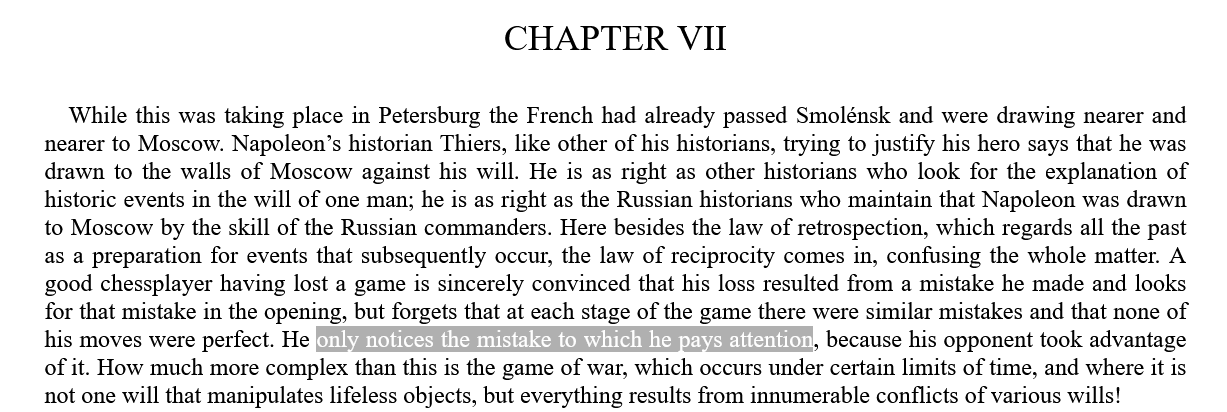
I'm going to read more about Tolstoy, Russia, and literary criticism of War and Peace. Then I want to reread War and Peace again. I'm sure there is so much I missed. Until next time, I'll leave you with my favorite chess quote.

Image

Thursday, November 18, 2021

“[They] were trying to look poor. They wore old jeans and shirts with the shirttails out, just like the [poor] always had because they couldn’t afford anything else. I’ll tell you one thing, though: what with fringed leather vests and Levis with classy-store labels in them, those kids were spending as much money to look poor as they used to to look rich.” S.E. Hinton That Was Then, This Is Now

Wednesday, November 17, 2021

Why I Love Into the Wild

I'm in debt to Jon Krakauer, Christopher McCandless, and Into the Wild. This was my fifth or sixth time reading Into the Wild. My previous read was close to 10 years ago. Since then I've learned so much more about so many things. I feel like a very different person now (this could be false, of course), but surprisingly I had a very similar reaction to Into the Wild.

This year, I decided to eventually reread all of my five star rated books. I follow the goodreads.com rating system, so a four star book is "I really liked it" and five star is "it was amazing." I'm a stickler for words, especially words like amazing. Amazing is a word that should be sparingly used, and I expect to downgrade many of my five star ratings. Currently, about ten percent of my rated books are five stars, and my average rating is 3.27. 

Into the Wild will not be a downgraded. I love Into the Wild. The structure of the book feels a bit cliche now. So many writers use quotes to start chapters and tell nonlinear stories, but it works. Krakauer is a master of his craft. Having heard a few Krakauer interviews and reading a few of his other books, I know how much time and effort he put into the organization of the story and ideas. It is as perfect as a writer can hope to achieve.

When I first read Into the Wild, I was about McCandless' age when he died. I related to everything. I agreed with McCandless and shared his ambitions to live life fully and be a good person. I read Into the Wild before my spring break. When spring break hit, I hit the road. I hitch hiked to Los Angeles then to Las Vegas. It was frustrating exhilarating. Even the waiting for rides and having to eventually fly home from Vegas after a failed day of hitch hiking, it all felt worth it. Some of the random people and conversation I had remain with me today.

Into the Wild, along with a liberal college education, a couple philosophy courses, and living the poor college student life, led me to appreciate a more ascetic lifestyle. The less I had, the happier I felt. I started backpacking. I became more intense about living life by a more vigorous standard which was also more rewarding. I'd revisit the book multiple times in my 20s. I was, what a friend labeled me as, an experience junkie.

Most importantly, it had a huge impact on who I am today. Into the Wild gave me reasons to value reading. Becoming a reader took a while. I made a scrap paper bookmark list of all the books that McCandless and Krakauer mentioned. I carried that scrap paper around several states and at least a couple continents. I didn't read all the books, but it implanted a seed to read. And that seed flourished into a decent tree, a tree with many branches and hundreds of leaves.

War and Peace was the monumental book on that list. I'd love to recall what I thought about War and Peace before and after reading it. I remember thinking it was one of the longest books ever written (it's not!) and that is about it. 1,500 pages (depending on the version) was a daunting obstacle to me. But McCandless' love for War and Peace rubbed off. I wanted to know why MecCandless told his friend Wayne, "That is a very powerful and highly symbolic book. It has things in it that I think you will understand. Things that escape most people." I wanted to understand it. It took me several years and many books before I tackled War and Peace. It is another one of my favorite books. I'm rereading it as I write this review. (Click here for my reread response to War and Peace)

In 2021, I'm closer to Krakurer's age when he wrote Into the Wild. I see McCandless through a different lens. He is more radical, too risk seeking, and stubborn. My last reading, I was a single Peace Corps volunteer in my late 20s. This time, I'm a married homeowner, barely employed/part time substitute teacher, stay at home-ish spouse/dad, and dog owner in my late 30s. I've learned more about every aspect in life. I'm more moderate in my ideas and values. I have more knowledge and interest in philosophy, economics, statistics, psychology, evolution, and science in general. I'm a superior thinker than I was. Still, the story is as readable, relatable, and relevant as it was in my 20s. It is easy to remember who I was and why I loved and still love this book so much.

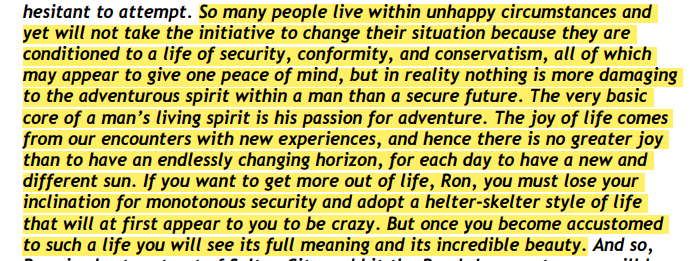
Although I disagree with McCandless's take on man's spirit, the following quote, and similar quotes, inspire me. They make me regret falling deep into a society. Something in me is trying to scream out. I can faintly hear it. I can't listen, but maybe I can feed the urges a couple times a year. 

Image

McCandless' advice is terrible. Unless someone had prior interest in this type of lifestyle, I wouldn't advise anyone follow a "helter-skelter style of life." People can find meaning and beauty potentially anywhere. Living in solitude in a nice house isn't what I'd advise either, and Ron probably needed a push back to a more meaningful life, but he had a lot of other options too. With that said, I'm one of the unhappy people with their circumstances. I long for more nature and less civilization, more adventure and less monotony, but I have other responsibilities. Otherwise rereading Into the Wild may have sent me on a trip.

McCandless' life and death makes the reader wonder. What would have McCandless become if he successfully walked out of his wilderness adventure? Would he be a more moderate family man, like me? Would he be a successful writer like Krakatau? Would he have died taking on another risky adventure? How many people successfully live adventurous lifestyles unknowingly and without fatal outcomes? How many others meet a fatal outcome without any mainstream media covering it? (I'm curious to explore the last two questions) It's hard to say. McCandless was approaching an age where young men start to recalculate the rewards of risky behaviors. He may have settled down and been one of those eccentric high school teacher that students love.

This is where Krakauer's perspective is perfect for telling McCandless' story. When I first read Into the Wild, I thought Krakauer was highjacking too much of the story with his personal experiences. It felt like distractions. Many critical responses to Into the Wild make that claim, and it's a bad and unfair critique. It is clear how well crafted the story is on critical examination. It is similarly clear how important Krakauer's life is to telling McCandless' story. Krakauer was a McCandless. Many of us were in some to many ways. The book includes other historical figures with tragic deaths trying to live off the land or be one with nature, etc. I love these stories too. McCandless and his tragic peers wanted more; they took risks; and they died living their ideals. They are romantic outdoor extremists. It is a fun paradox for readers to evaluate.

Over the summer I found the best explanation for McCandless and his tragic peers.

"His actions were hardly those of a sportsman... there is only one word for what was happening in Hans Castorp's soul: defiance." 

Hans Castorp is the fictional protagonist in Thomas Mann's The Magic Mountain (another five star book). Castorp was a 20 year old who spends 7 years at a sanatorium in the Swiss Alps. Castorp experienced a near death hallucination after ignoring the warning signs of a blizzard. In addition to being ill equipped for his adventure, Castorp used awful judgement. He should have died, but his story is for another book review. Castorp is a McCandless. And his defiance, in the chapter titled "Snow," should be paired with McCandless' death. I will always read "Snow" with Into the Wild. When Krakuaer speculates on McCandless' death, pause, and go read the chapter "Snow" from The Magic Mountain.

Into the Wild is a story of defiance. You cannot understand McCandless or his peers without defiance. It's defiance against society, cultural norms, familial expectation, etc.

Defiant readers should love Into the Wild. If you were defiant, want to be defiant, or know defiant people, then Into the Wild is for you. If you liked Into the Wild, I strongly recommend rereading it and reading Jon Krakauer's other books

I recently read The Stranger in the Woods: The Extraordinary Story of the Last True Hermit by Michael Finkel. This is another excellent story about a McCandless type character.

Friday, November 12, 2021

Love Your Enemies

Arthur C. Brooks' book Love Your Enemies motivated me to write him an email. I'm going to expand on that email I sent and make a quasi book review-ish reflection and response to his book. I would recommend everyone at least read the conclusion of Love Your Enemies.

I must admit, the book is somewhat confirmation bias for me. I heard an interview with Brooks and liked the discussion. Then the books mostly provides further evidence and arguments that strengthen my previously ideas. I don't think that is necessarily bad, but that is where I'm coming from. I'm open to alternative and opposing ideas. If anyone knows any please leave them in a comment.

Love Your Enemies is organized very well. Brooks weaves a quasi narrative throughout the book with anecdotes and studies to reinforce his ideas and build on previous ideas. Brooks' anecdotes are appropriate to the story he is telling (more on that below) that people should be more loving to people, especially when they disagree. The book flows effortlessly. It is the kind of book that calls me to action. It inspired me to write a more thoughtful response than I normally would for a book.

Every Thanksgiving, right around this time, I usually make a plan to be more grateful. Thanksgiving is the perfect reminder of how ungrateful people are, myself included. This book is a call to gratitude. It offers an argument to be grateful for differing opinions too.

The book is an easy read or listen.  The ideas are useful and practical advice everyone can apply today. I can't imagine a person not having better conversations after reading this book. This book offers solutions, at least on the individual level.

Those that know me, know I like to argue. But I've noticed myself arguing more and more against ideas I might have accepted prior to the 2016 election. I consider myself a moderate and more of a classical liberal, but many of my friends and family members are antivaccination Trump supporters. I don't think or assume negative attributes to people based on 1 or 2 factors, ideas, or especially voting habits. I know plenty of Trump supporters who are great people, and  I know antiTrumpers who could be a lot better. Over the last 5 years, I have constantly engaged with bad ideas on the left (I do the same with conservatives and the bad ideas on the right, but the conversations are different, maybe I'll explore that too). People, even my friends, have accused me of being all sorts of insults. My favorite is when they say I must watch foxnews. Love Your Enemies offers another reason why I have argued so often and much with liberals: loyalty. When people attack and make generalizations about all "Trump voters," they are making an indirect attack on me through people I love. I realize now that my loyalty to my family was probably a lot bigger influence that I would have previously accepted or thought. Knowing this now will help me not take other people's cognitive distortions personally which should result in better conversations and hopefully better informed interlocutors.

The book references other books I enjoyed like Coddling of the American Mind, another a must read. After reading Coddling of the American Mind I investigated Cognitive Behavioral Therapy (CBT). I learned a lot from CBT, especially avoiding and recognizing cognitive distortions. Love Your Enemies pairs very well with The Righteous Mind, Coddling of the American Mind, and "Denialism: what is it and how should scientists respond?" I regularly listen to Michael Shermer’s podcast. Shermer is where I get many of my nonfiction book recommendations. Shermer covers science denial a lot. Love Your Enemies could be adopted as a strategy for talking to science deniers.

I have a problem with chapter 6 "Telling more Stories." Brooks adds and tells stories well in his book and I agree it is a successful strategy to engage readers/viewers. But I also see this as a problem. Stories can easily manipulate people into cognitive distortions, like making generalizations or jumping to conclusions without sufficient evidence. Brooks briefly discusses this dilemma. I prefer the opposite approach. Teach people to be aware of statistics and recognize that one people studies, aka anecdotes, are not reliable information for a big picture understanding. When someone gives a story or anecdote, we need further support to accept the prevalence of that issue/idea. X happened to Person A. Okay, but how many people similar to Person A didn't have X occur? If Person B tries to do Z, what are the chances of Person B succeeding? People need to understand statistics and probability and know when a media source is using a story in good or bad faith. Using a story as an attention grabber and then providing evidence to support the main idea is good faith. Using a story to emotionally create a response to sell an idea without providing evidence is bad faith. Those are generalization. For instance, using selection bias and ignoring conflicting ideas would be bad faith. I'll save that for another rant (Malcolm Gladwell comes to mind as the king of selection bias to persuade people vs inform people). I'm not anti story. I'm pro story and pro critical thinking.

Check out Love Your Enemy! Even if you think you don't need it. You can't get too much advice for love and kindness. Love and kindness with good intentions are never bad ideas.