Showing posts with label 5 star reread. Show all posts

Friday, May 30, 2025

Rereading Song of Solomon by Toni Morrison

Rereading Favorite Books

I've been slowly rereading my favorite books. My friend AJ has joined me for most of them.

Song of Solomon by Toni Morrison is one of favorite rereads so far. Here is a lightly revised review from when I first read the book in 2020.

This book had me hooked. I read Beloved and liked it, but it was a tough read. This book is easier to read and follow, but one can also dive deeper and be jealous and amazed at how skilled Toni Morrison was. I'm going to binge her work for a while (and I did).

The dialogue is excellent. I don't always pay close attention to dialogue. It's easy to notice when it's bad. But I can't recall a book or movie with better dialogue. The characters' voices are unique and funny, and their conversations are fresh.

The plot and drama builds and reveals. I was content the whole read. And then every other chapter or so there were surprises I never expected. Everything connects and comes back. The craft is perfect.

Rereading Song of Solomon 

As much as I liked it last time, it was even better this time. Knowing the story and characters had me especially attentive to all the details Morrison puts into her craft, seeing more clearly how characters are formed and evolved throughout the story.

The plot is full of action and suspense.

It's a male centered point of view, but the female characters stand tall. The main character Milkman is finding his way through two opposing extremes of his day. Milkman is born into a rich northern black family. He journeys to the rural south for something and if you want to find out if he finds it, you'll have to read the novel.

Here is a taste of the dialogue:

“Like a riverboat pilot?” Macon asks.
“No not like no riverboat pilot. Like a Christ-killer Pilate. You can’t get much worse than that for a name. And a baby girl at that.”
“That’s where my finger went down at.”
“Well your brain ain’t got to follow it. You don’t want to give this motherless child the name of the man that killed Jesus, do you?”
“I asked Jesus to save me my wife.”
“Careful, Macon.”
“I asked him all night long.”
“He give you your baby.”
“Yes. He did. Baby name Pilate.”
“Jesus, have mercy.”
“Where you going with that piece of paper?”
“It’s going back where it came from. Right in the Devil’s flames.”
“Give it here. It comes from the Bible. It stays in the Bible.”
And it did stay there, until the baby girl turned twelve years old and took it out, folded it up into a tiny knot and put in a little brass box, and strung the entire contraption through her left earlobe (19).

Here are a couple other quotes that stood out to AJ and I:

A glimpse at the theme of love:

“Gimme hate, Lord,” he whimpered. “I’ll take hate any day. But don’t give me love. I can’t take no more love, Lord. I can’t carry it...It’s too heavy. Jesus, you know, you know all about it. Ain’t it heavy? Jesus? Ain’t love heavy?" 

Milkman's feelings toward Hagar:

She was the third beer. Not the first one, which the throat receives with almost tearful gratitude; nor the second, that confirms and extends the pleasure of the first. But the third, the one you drink because it's there, because it can't hurt, and because what difference does it make?

Guitar trying to comfort Hagar:

“You can't own a human being. You can't lose what you don't own. Suppose you did own him. Could you really love somebody who was absolutely nobody without you? You really want somebody like that? Somebody who falls apart when you walk out the door? You don't, do you? And neither does he. You're turning over your whole life to him. Your whole life, girl. And if it means so little to you that you can just give it away, hand it to him, then why should it mean any more to him? He can't value you more than you value yourself.” 

The opening of the book:
The North Carolina Mutual Life Insurance agent promised to fly from Mercy to the other side of Lake Superior at three o'clock. Two days before the event was to take place he tacked a note on the door of his little yellow house:

At 3:00 p.m. on Wednesday the 18th of February, 1931, I will take off from Mercy and fly away on my own wings. Please forgive me. I loved you all.
 
(signed) Robert Smith,
Ins. agent
 
More on flying:
“How come it [peacocks] can't fly no better than a chicken?"
"Too much tail. All that jewelry weighs it down. Like vanity. Wanna fly, you got to give up the shit that weighs you down.” 
 
The last sentence of the book:
If you surrendered to the air, you could ride it.

 
I could keep going. The book is full of great writing. 

Teaching Tools

If I ever find myself teaching again and I'm lucky enough to teach this book, I want to save these resources. I briefly skimmed them and might read some later. 

https://www.georgiaencyclopedia.org/articles/history-archaeology/ebos-landing/

https://commons.hostos.cuny.edu/columbiacommoncoreathostos/song-of-solomon/

https://scalar.lehigh.edu/toni-morrison/song-of-solomon-1977-overview-and-links

https://corebooks.commons.gc.cuny.edu/song-solomon-2/

Wednesday, August 21, 2024

2024 Five Star Rereads (update)

Update on a previous post. I want to reread all my favorite books. My friend AJ joined me. We were on a roll and then fell off. I recently started again. See here for my mid way response to It's Not About the Bike.

5 Stars to Reread 2024
  • Half a Yellow Sun
  • Waiting for the Barbarians
  • Zen in the Martial Arts
  • Dispatches
  • Song of Solomon

5 Stars Reread Results

Here are my five star rereads that kept their five stars:

The following are still really good, but not five stars after rereading:

Here are the nowhere near five stars:

So far, my original five star ratings are shooting nine for thirteen (~69%), with 12/13 being at least really good, not bad.

Wednesday, November 17, 2021

Why I Love Into the Wild

I'm in debt to Jon Krakauer, Christopher McCandless, and Into the Wild. This was my fifth or sixth time reading Into the Wild. My previous read was close to 10 years ago. Since then I've learned so much more about so many things. I feel like a very different person now (this could be false, of course), but surprisingly I had a very similar reaction to Into the Wild.

This year, I decided to eventually reread all of my five star rated books. I follow the goodreads.com rating system, so a four star book is "I really liked it" and five star is "it was amazing." I'm a stickler for words, especially words like amazing. Amazing is a word that should be sparingly used, and I expect to downgrade many of my five star ratings. Currently, about ten percent of my rated books are five stars, and my average rating is 3.27. 

Into the Wild will not be a downgraded. I love Into the Wild. The structure of the book feels a bit cliche now. So many writers use quotes to start chapters and tell nonlinear stories, but it works. Krakauer is a master of his craft. Having heard a few Krakauer interviews and reading a few of his other books, I know how much time and effort he put into the organization of the story and ideas. It is as perfect as a writer can hope to achieve.

When I first read Into the Wild, I was about McCandless' age when he died. I related to everything. I agreed with McCandless and shared his ambitions to live life fully and be a good person. I read Into the Wild before my spring break. When spring break hit, I hit the road. I hitch hiked to Los Angeles then to Las Vegas. It was frustrating exhilarating. Even the waiting for rides and having to eventually fly home from Vegas after a failed day of hitch hiking, it all felt worth it. Some of the random people and conversation I had remain with me today.

Into the Wild, along with a liberal college education, a couple philosophy courses, and living the poor college student life, led me to appreciate a more ascetic lifestyle. The less I had, the happier I felt. I started backpacking. I became more intense about living life by a more vigorous standard which was also more rewarding. I'd revisit the book multiple times in my 20s. I was, what a friend labeled me as, an experience junkie.

Most importantly, it had a huge impact on who I am today. Into the Wild gave me reasons to value reading. Becoming a reader took a while. I made a scrap paper bookmark list of all the books that McCandless and Krakauer mentioned. I carried that scrap paper around several states and at least a couple continents. I didn't read all the books, but it implanted a seed to read. And that seed flourished into a decent tree, a tree with many branches and hundreds of leaves.

War and Peace was the monumental book on that list. I'd love to recall what I thought about War and Peace before and after reading it. I remember thinking it was one of the longest books ever written (it's not!) and that is about it. 1,500 pages (depending on the version) was a daunting obstacle to me. But McCandless' love for War and Peace rubbed off. I wanted to know why MecCandless told his friend Wayne, "That is a very powerful and highly symbolic book. It has things in it that I think you will understand. Things that escape most people." I wanted to understand it. It took me several years and many books before I tackled War and Peace. It is another one of my favorite books. I'm rereading it as I write this review. (Click here for my reread response to War and Peace)

In 2021, I'm closer to Krakurer's age when he wrote Into the Wild. I see McCandless through a different lens. He is more radical, too risk seeking, and stubborn. My last reading, I was a single Peace Corps volunteer in my late 20s. This time, I'm a married homeowner, barely employed/part time substitute teacher, stay at home-ish spouse/dad, and dog owner in my late 30s. I've learned more about every aspect in life. I'm more moderate in my ideas and values. I have more knowledge and interest in philosophy, economics, statistics, psychology, evolution, and science in general. I'm a superior thinker than I was. Still, the story is as readable, relatable, and relevant as it was in my 20s. It is easy to remember who I was and why I loved and still love this book so much.

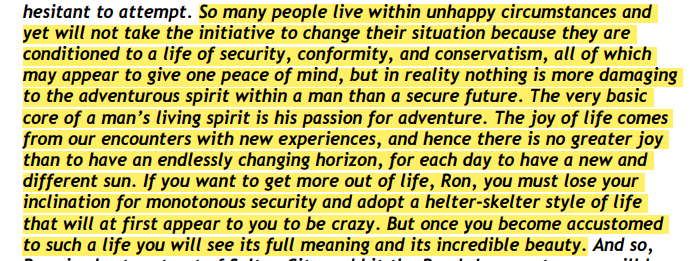
Although I disagree with McCandless's take on man's spirit, the following quote, and similar quotes, inspire me. They make me regret falling deep into a society. Something in me is trying to scream out. I can faintly hear it. I can't listen, but maybe I can feed the urges a couple times a year. 

Image

McCandless' advice is terrible. Unless someone had prior interest in this type of lifestyle, I wouldn't advise anyone follow a "helter-skelter style of life." People can find meaning and beauty potentially anywhere. Living in solitude in a nice house isn't what I'd advise either, and Ron probably needed a push back to a more meaningful life, but he had a lot of other options too. With that said, I'm one of the unhappy people with their circumstances. I long for more nature and less civilization, more adventure and less monotony, but I have other responsibilities. Otherwise rereading Into the Wild may have sent me on a trip.

McCandless' life and death makes the reader wonder. What would have McCandless become if he successfully walked out of his wilderness adventure? Would he be a more moderate family man, like me? Would he be a successful writer like Krakatau? Would he have died taking on another risky adventure? How many people successfully live adventurous lifestyles unknowingly and without fatal outcomes? How many others meet a fatal outcome without any mainstream media covering it? (I'm curious to explore the last two questions) It's hard to say. McCandless was approaching an age where young men start to recalculate the rewards of risky behaviors. He may have settled down and been one of those eccentric high school teacher that students love.

This is where Krakauer's perspective is perfect for telling McCandless' story. When I first read Into the Wild, I thought Krakauer was highjacking too much of the story with his personal experiences. It felt like distractions. Many critical responses to Into the Wild make that claim, and it's a bad and unfair critique. It is clear how well crafted the story is on critical examination. It is similarly clear how important Krakauer's life is to telling McCandless' story. Krakauer was a McCandless. Many of us were in some to many ways. The book includes other historical figures with tragic deaths trying to live off the land or be one with nature, etc. I love these stories too. McCandless and his tragic peers wanted more; they took risks; and they died living their ideals. They are romantic outdoor extremists. It is a fun paradox for readers to evaluate.

Over the summer I found the best explanation for McCandless and his tragic peers.

"His actions were hardly those of a sportsman... there is only one word for what was happening in Hans Castorp's soul: defiance." 

Hans Castorp is the fictional protagonist in Thomas Mann's The Magic Mountain (another five star book). Castorp was a 20 year old who spends 7 years at a sanatorium in the Swiss Alps. Castorp experienced a near death hallucination after ignoring the warning signs of a blizzard. In addition to being ill equipped for his adventure, Castorp used awful judgement. He should have died, but his story is for another book review. Castorp is a McCandless. And his defiance, in the chapter titled "Snow," should be paired with McCandless' death. I will always read "Snow" with Into the Wild. When Krakuaer speculates on McCandless' death, pause, and go read the chapter "Snow" from The Magic Mountain.

Into the Wild is a story of defiance. You cannot understand McCandless or his peers without defiance. It's defiance against society, cultural norms, familial expectation, etc.

Defiant readers should love Into the Wild. If you were defiant, want to be defiant, or know defiant people, then Into the Wild is for you. If you liked Into the Wild, I strongly recommend rereading it and reading Jon Krakauer's other books

I recently read The Stranger in the Woods: The Extraordinary Story of the Last True Hermit by Michael Finkel. This is another excellent story about a McCandless type character.