From the book The Science and Practice of Middle and Long Distance Running, in the chapter titled "Nutritional Requirements for Distance Runners."

From the book The Science and Practice of Middle and Long Distance Running, in the chapter titled "Nutritional Requirements for Distance Runners."
I've been very focuses on my running the last several weeks. For the first time in over 15 years that I have created and followed a training plan. I have not missed a workout or run in the last six weeks. Now, that I finished my last quality workout yesterday, I have transitioned to my tapering. And I'm focusing on other aspects of the race. I made this warmup routine specific to me. My usual warmup for workouts includes more lunges and a few other mobility/yoga poses. But I cut everything that isn't directly preparing me for running a 5k. Here is my sheet if anyone wants to copy and paste it.
Prevention is the goal, but whether you're doing prevention or rehab the following plan below will be helpful. Before the plan, here is the most basic guidelines to avoid injuries. I'm in my 40s and this is specifically for a couple friends in their 40s, but it generally applies to everyone.
Now for the Plantar Fascia Plan.
What is the plantar fascia?
The plantar fascia (PF) is not a tendon (tendons connect muscle to bone, like the achillies tendon) and it isn't considered a ligament either (ligaments connect bone to bone). The technical name for the plantar fascia (PF) is aponeurosis.
The PF is a dense connective tissue made of collagen fibers, mostly Type I collagen. The PF connects the heel bone (at the calcaneal tuberosity) to the balls of the foot (metatarsal bones). It supports to the arch of the foot, provides shock absorption, and stores and releases elastic energy.
Why does my plantar fascia hurt?
The pain is probably in your heel and it's probably your plantar fascia.
As mentioned above, you overloaded the fascia by some combination of overuse, excess strain, or biomechanics (inflexibility, most likely in the foot, calf, or hamstring). You can't undo the past. But you can identify the issue. Check the flexibility and mobility in your feet, ankles, calves, hamstrings, and might as well check the hips too. Look back at your recent actives/training/work/etc. Have you increased volume and or intensity? Do you have tightness or other problems putting extra strain on your foot?
Flexibility Diagnostic
Test yourself on the following. If you do not have at least the minimal flexibility, you should work on increasing your flexibility. If you have the minimal flexibility, then you're fine and don't need to work on increasing your flexibility for running.
How long will it take to heal?
It could take weeks to months. There are three phases to consider: inflammation phase, repair phase, and remodel phase. People with chronic heel pain are probably well past the inflammation phase.
The first few days are the inflammation phase. The body is sending blood, cells, and nutrients to the damaged site. The heel might feel painful, but many runners will not notice the inflammation phase. There may be redness and swelling.
The next couple weeks the body repairs the tissue. Fibroblasts are working to create new collagen fibers. The new fibers (Type III collagen) are weaker than the original Type I collagen that was damaged. New blood vessels form to aid in supplying oxygen and nutrients. Scar tissue forms to assist the healing. The PF may feel stiff and painful, especially in the morning or after prolonged sitting.
The next months the new tissue will be remodeled. The Type III collagen matures into Type I collagen. The fibers realign and become stronger. The excess scar tissue breaks down. The fascia gradually regains its normal structure and function.
Expect even a mild plantar fascia injury to takes months to heal. For more severe and chronic cases it can take over a year to recover.
During these phases the injured person should work on strengthening and stretching.
What can I do?
The Plantar Plan
Depending on how much time you have, make a plan using the following exercises. If you can, formally set time for 5-15 minutes 2-3 times a day, that's 10-45 minutes a day.
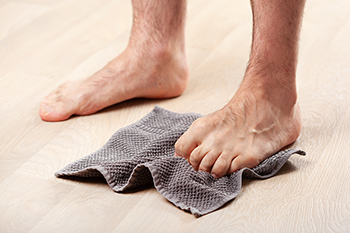
If not formally, informally make time by doing the following. Balance on one foot while you brush your teeth. Roll your feet on a baseball or frozen water battle while you work at a desk. You can do the towel curls without a towel on a rug or hard floor. Find other ways to work in the following exercises into your current daily routines. If you watch TV or browse the internet you have time! You can do towel curls in your car while you drive. Here is a good video that covers most of the exercises. The bolded exercises below are primary and the unbolded are secondary. There's overlap between the exercises too.

I've always liked running faster than slower. My favorite workouts were hill repeats and track intervals. Even before I knew that intervals provided the best return on investment for time and distance, I like those type of workouts best.
But, there's always a but, those workouts are the most dangerous. The quality aspect of the running increases the risk of injuries from the increased stress of the faster running. With age, and decreased running, intervals helped me maintain my fitness with less mileage, but eventually the intervals just lead me to injuries.
After several years of injuries and inconsistent running, I was able to build a decent base over the last 18 months. I never fully realized the value in building a running base. Intervals get you fitter faster, at a risk, but running slower and injury free compounds over time!
This post is a follow up to this previous post.
My Anecdotal Evidence
Everything is relevant, but most people and runners would agree I was fast in my 20s. Here were my running PRs (personal records).
5k- 16.42
10 mile- 60.15
I realize that some of my 2024 gains were building on my 2023 fitness, but still I think the running below speaks for itself. In 2024, I didn't do more intervals or tempo runs than I did in 2023 (I would have but I got plantar heel pain, see below). I just ran a lot more. And the more I ran, the easier running got. My HR decreased and my cadence increased. It didn't just change in the races, it changed in all my runs. See my running tables below.
I wasn't completely injury free, I ended up getting plantar heel pain. It's hard to say why because I added 3 different stimului all around the same time (which I know and knew was a mistake, but I was feeling really good and the plantar crept in on me). I added a weekly hill repeat, strides, and structured weight lifting (deadlift, squats, and cleans two times a week). I eased into each activity, but I didn't consider the effects of easing into all three activities at the same time. I ended up dropping the hills and strides and keeping the lifting.
Conclusion
Consistency wins! Any sport or exercise, the results and effects compound with time doing the activity. It's innumerably better to start slow and build up than to get injured and or quit.
Good luck and I hope I can help anyone reading this learn from my mistakes.
2023 Training
2024 Training
I recently interviewed (listen here) the hosts of Running Book Reviews with Alan and Liz, a podcast that reviews running books. Of course, we mentioned a lot of books. Here are the books in order as they were mentioned.
Non Running Books
Running Fiction
Nonfiction, non training, Running
Nonfiction, Training, Running Books
Non Running Nonfiction
I recently interviewed (listen here) the hosts of Running Book Reviews with Alan and Liz, a podcast that reviews running books. They have reviewed over 90 running books, but only two of those books have been fiction. Which made me wonder about running fiction. Why aren't there more running novels and fiction? And if there are, why aren't they more popular among runners?
I suspect that when it comes to running, and probably sports in general, reality is better than fiction. People would rather read about the athlete who won the gold medals, championships, and records than an athlete an author created. Regardless of the reason, it is very clear that running fiction is ultra marathons less popular than running nonfiction.
Join The Running Fiction Challenge.
Most Popular Running Fiction
The following books are the most rated running fiction on goodreads.com, as of 6 July 2024. Goodreads readers can vote here for the best running fiction.
I haven't read any of the books mentioned above. I'd like to at least check out a chapter or two of each. If I do, I'll report back to see if my theories hold any water, pun intended (see below).
Intro to the Theory
Running is underrepresented in fiction (maybe). Writers, novelists especially, aren't using runners as characters or aren't focusing on their running for topics and plots.
Maybe runners don't like fiction and that demand influences writers.
That could be true. Runners are more active people, and active people
might spend less time sitting and
reading. This could be true. But then running books are very popular.
It's running
fiction that isn't as popular.
The theories below are based on my understanding of people, readers, writers, and fiction. I didn't look up or verify any of the ideas present. I'm shooting from the hip here. Still, I think my ideas are plausible explanations for at least some of the imbalances between running fiction and running nonfiction. I'll take any and all feedback.
Inauthentic Determination
Lance Armstrong had one of the most inspiring stories of my generation. Even after being exposed by teammates and experts in cycling, people still believed and wanted to believe Armstrong's story. I admit that I was one of them. Eventually, Armstrong was revealed to be an elite cheater and asshole on top of his elite athletic abilities. I'd argue his story is still great, really, the fictional one he describes in his books and the cautionary tale of his real life. But clearly, Armstrong's story has lost most, if not all, of it's appeal to people. Watch ESPN's "LANCE" for the more accurate story of Armstrong. See my review of his book here.
Armstrong deserves all the negativity he has received and will receive, and still, I like Armstrong's story of what it really takes to be the best. Maybe that is the only way to tell Armstrong's story. He has to be the bad guy or the tragic hero who falls.
People loved the fairy tale of the man who beat cancer then beat one of the most grueling sporting events seven years in a row. Remember all the "Live Strong" bracelets? Lance was loved, until his fairy tale was fictional. Part of our disgust with Armstrong is the fictional aspects of his story. People love the fairy tales only when they are real, or when they think they are real.
Inauthentic fairy tales don't work.
Conflict Drives Stories
Fiction has a few basic necessities, but none more essential than conflict (cancer is a great conflict, by the way). So no conflict, no story.
Example 1
Jeff was thirsty when he called to his daughter Eve, "Evie, water!"
Eve brought Jeff a cup of water. Jeff drank the water.
Example 2
Jeff was thirsty. He went to the sink to get water, but the tap wouldn't release water. It was late and Jeff was a lot more tired than thirsty, so he went to sleep without getting a drink.
In the morning, Jeff woke up to neighbors yelling. He went outside.
"None of us have any water!"
"Can't be possible--"
"Did you see the news this morning? Cities all over the world were reporting no water."
"And now the internet and electricity is out!"
It was true. All the water on Earth seemed to have disappeared the previous night...
I made both of these up as I wrote because I was thirsty and my water bottle was empty. It's not that example 2 is good, it's not, but it's a lot better than example 1. The water thing probably doesn't work, but the conflict is there. Readers will be a lot more interested in a thirsty Jeff on a planet with no water than in the Jeff who easily gets water. Example 2 has more details and dialogue, but the main thing it adds is conflict.
Think of any great story. The story is good because of how the characters deal with conflict and struggle to get what they want. It is how and why and not so much what, where, nor when.
Running history books, biographies, and memoirs are very popular because they have authentic conflicts and authentic achievements. Readers want to know the inspiration is authentic and deserved.
Team Conflict > Individual Sport Conflict
Running is less of a team sport. Conflict impairs running. Being a great runner is pretty boring stuff. Runners need to eat well, sleep well, and live well. Professional runners spend a full-time job amount of time training and preparing their bodies for running and racing. There is a lot less room for interesting conflicts in the most elite runners. Having a lot of interesting conflicts impedes performance. This ties back to authentic determination. The authentic lifestyles of professional runners are too boring for fiction.
The characters don't have to be professional runners. But then, they don't have to be runners period. Maybe more characters are runners. But their identity as runners and time running isn't focal to the conflicts and plot of stories.
Team sports, like basketball or football, have so many greater opportunities for characters to interact and be thrown into conflict. Think of the tropes, the underdog, the aging player who has to accept a new role, the hotshot who has to learn to be a team player, etc. The team setting is a better environment for conflict and stories.
Conclusion
Real life stories are more authentic. More authentic sports stories are more interesting to viewers. Team sports present better opportunities for authors to create interesting and more authentic conflicts. Plus all other factors that I didn't mention. As a result, there is a lot less running fiction in libraries, and book stores.
This post was a few weeks before my two May races, see my full training comparison here.
Background
Last January, I started running after 15 months of no running. And several years of minimal running, occasionally running 10 miles a week, and regularly getting injured from weight lifting, basketball, and or running. My 15 months without running was due to a lingering ligament injury in my ankle. The first few months of my injury I had pain walking and swelling. Doctors and exams couldn't detect anything. The last few months I had phantom pain. I eventually saw three different PTs. The PT I liked and revisited helped me overcome the phantom pain and regain my confidence, with a couple minor set backs.
I was a recreationally fast runner in my 20s. I ran about 20 miles a week, and occasionally 30 miles a week for a race. I loved intervals; hill repeats and track workouts especially (this probably lead to me injury problems in my 30s). I could run sub 18 minute 5km with little to no specific training. I nearly broke 60 minutes on a 10 mile road race. I ran a 5 minute mile in training several times give or take a few seconds.
In my 30s, as mentioned, I battled injuries. I've finally built a 20 mile a week running base for the first time in several years. I acquired plantar fasciitis from adding hill repeats and strides too quickly over the winter. I didn't notice or pay much attention to the early signs waking up in the morning. Then after a session of hill repeats, my heal screamed at me the next morning. I cut the hill repeats, but it didn't go away. I cut strides and decreased my weekly mileage, but it didn't go away. I took a week off of running, but it didn't go away. I've decided to run through it. I'm wearing a compression sock and shoes whenever on my feet. I'm doing PT exercises for my plantar fascia. I'm messaging multiple times a day. It's not getting worse, but it's not going away either.
Last Year
Last May, I ran the Lilac 5k (Rochester, NY) on May 21st, and the next week I ran the Buffalo HM on May 28th. I wore my Saucony Kinvara 12 or 13 for both my HM and 5k. I went pretty much all out for the 5k and HM last year.
I averaged 8 miles a week last year, my highest weekly mileage was 16. I ran a 5k in 20.24 and the next week I ran a HM in 1.40.07
For the 5k, I didn't know or look up the course, so it a was big surprise when the first mile was all down hill. My legs were very sore for a few days after the race, and I was worried I wouldn't recover in time for my HM race.
Last year, the week before the HM I wasn't sure I could finish the half marathon because of my slow recovery from the 5k, my low mileage, phantom ankle pain, and knee aches. My knees were having inflammation and minor pain from the repetitive motion of running after ~70 minutes of running.
For the Buffalo HM, I wore knee compression on both knees and that solved the knee problems. The phantom pain was my biggest worry, and it was fine too.
Overall, I was not confident in my running or body last year. And with all that considered, I felt pretty good about my race results. I expect a lot better this year.
This Year as of Apr 25th, 2024
I originally wanted to break 90 minutes for the Buffalo Half Marathon, but due to plantar fasciitis I mention above, I haven't done any quality runs, just easy and long runs the last couple months. I've been doing max output sprints on a stationary bike a couple times a week. I've increased my cycling power by close to 100 watts, but who knows how that might transfer to running.
In 2024, I've been running 20 miles a week. I just did a 12 mile long run a couple days ago.
I'm going to run the same two races as last year. The Lilac 5k the week before the Buffalo HM. I'm considering wearing the same shoes and outfit as last year too. I want most of my gains to be actual fitness gains from training versus wearing faster and or lighter appeal, for example.
This year, I will be better prepared for the 5k, and due to my training volume, will be able to recover a lot better.
I'm curious what recommendations other runners would give for my last four weeks of training. I feel ready for a 14 mile long run. I think I could progress up to a 40-45 minute tempo run prior to my 5k (4x10min, 3x15min, 2x20min). I'm curious what bench mark training session I should/could do to evaluate my potential 5k and HM goal times.
2023 Training2023 Training Log

2024 Training


